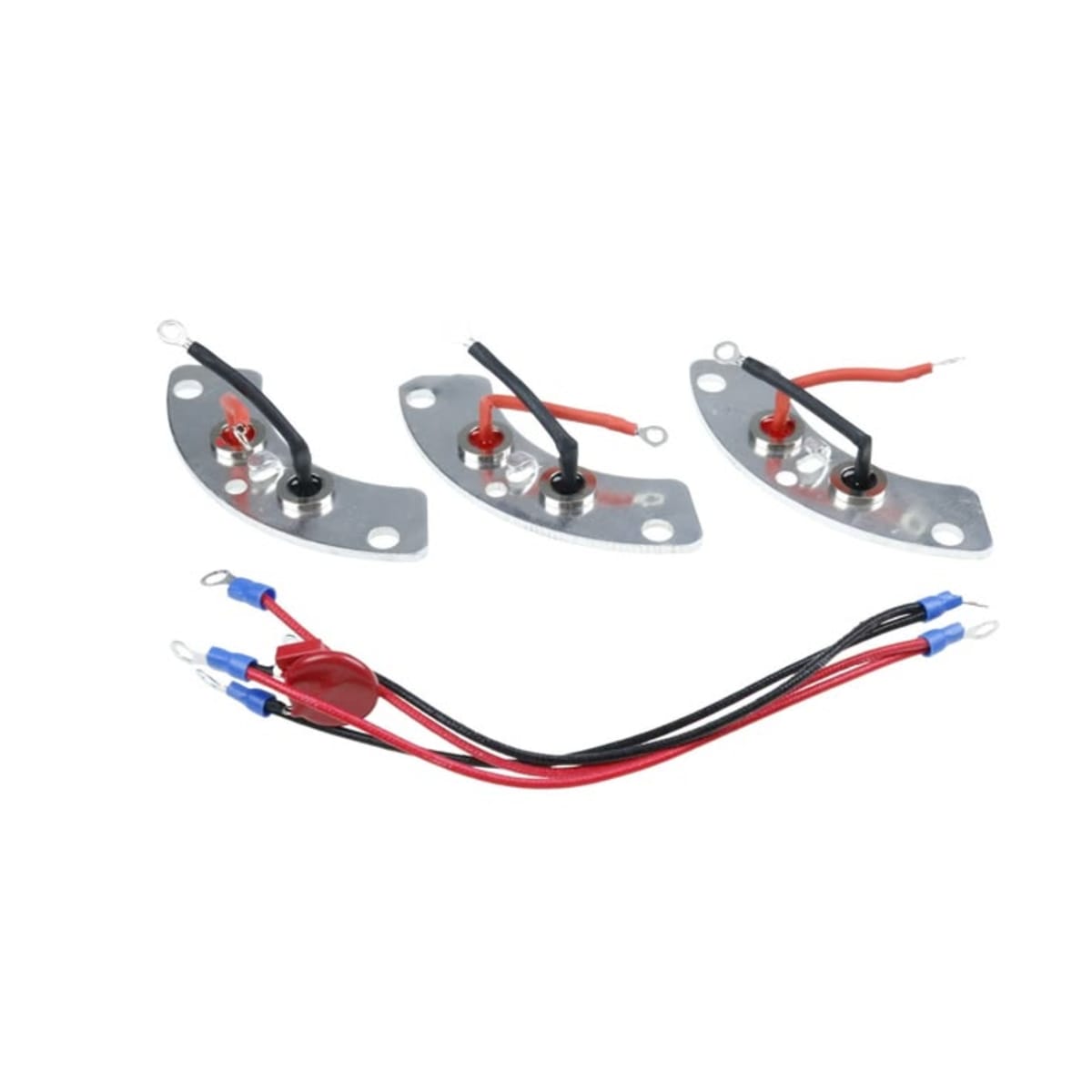
What the Rotating Diode Set (Brushless Alternator) does
A brushless alternator has no brushes to feed its main field. Instead, a small exciter on the shaft generates AC, and a rotating rectifier — six diodes and a surge suppressor (varistor) mounted on a plate — turns it into DC for the main rotor.
If one diode fails open, output drops and the AVR works harder to compensate; if one fails short, voltage can collapse and the AVR may be damaged. Diode failure is one of the most common causes of "no voltage" faults we see.
Signs it needs replacing
- Low or no output voltage although the AVR is supplying field current.
- The AVR running hot or failing repeatedly.
- Voltage that drops away as the alternator warms up.
- A burnt or cracked varistor on the rectifier plate.
Get the right part first time
Send us these on WhatsApp and our engineers will confirm the exact part before you pay:
- The alternator nameplate (make, frame and serial number).
- A photo of the rectifier plate showing the diodes and how they are mounted.
Fitting notes
Each diode is tested in both directions with a multimeter or diode tester; the full set and the varistor are usually replaced together, because the remaining diodes have seen the same stress. Diodes must be fitted with the correct polarity (three forward, three reverse) and torque. Afterwards the voltage is checked at no load and on load.
Frequently asked questions
How many diodes are in a set?+
Six: three forward-polarity and three reverse-polarity diodes, plus a surge suppressor (varistor) across the DC output.
Should I replace only the failed diode?+
We recommend the full set and the varistor. The others have been through the same fault and a single new diode leaves the rest as the next failure.
What causes diodes to fail?+
Voltage spikes (often from switching or lightning), overloading, and loose or overheated connections. A healthy varistor protects the diodes from spikes.