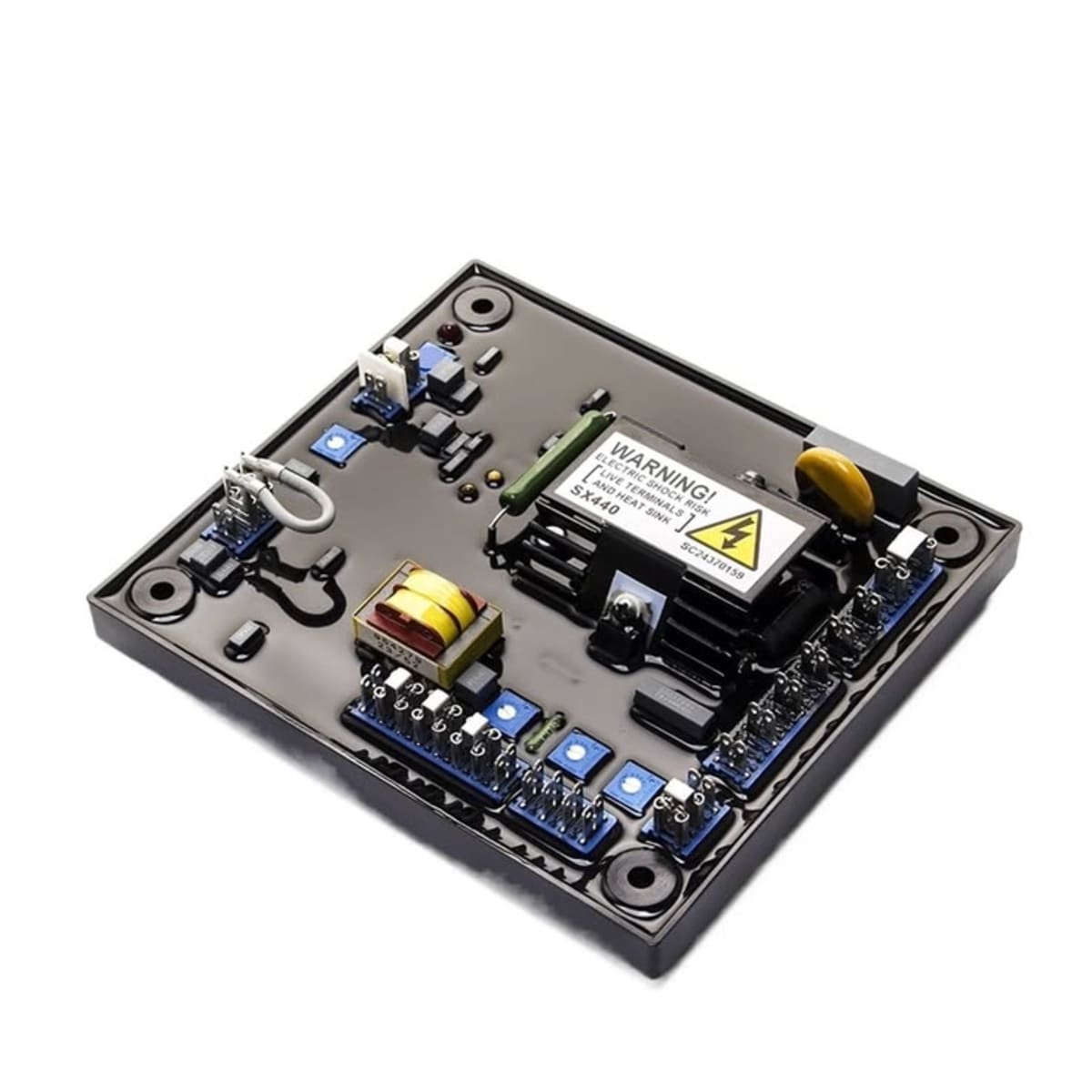
What the Stamford SX460 AVR does
The automatic voltage regulator (AVR) is the alternator's brain. It measures the output voltage and adjusts the current to the exciter field many times a second, so your supply stays at the right voltage as lifts, pumps and air-conditioning switch on and off.
The SX460 is the standard AVR on smaller self-excited Stamford (Newage) alternators, the UC22 and UC27 frames found on a large share of the FG Wilson, Perkins- and Cummins-engined sets installed in Kenyan offices, schools and hotels. Larger Stamford frames usually use the MX341 or MX321 instead, so check the AVR fitted before ordering.
Signs it needs replacing
- No output voltage, or only a few volts, with the engine running at normal speed.
- Voltage that hunts up and down, making lights flicker — especially when load changes.
- Over-voltage that trips equipment or blows bulbs.
- Voltage that collapses when a large motor starts and does not recover.
- Visible burning, cracked components or a burnt smell on the AVR board.
Get the right part first time
Send us these on WhatsApp and our engineers will confirm the exact part before you pay:
- The model printed on your existing AVR (SX460, SX440, MX341…).
- The alternator nameplate (frame, e.g. UC274, and serial number).
- A photo of the generator nameplate (make, model, kVA, serial number).
Fitting notes
An AVR is wired into the sensing, power and exciter field circuits; a wrong connection can destroy the new unit or the exciter. After fitting, voltage, stability and the under-frequency roll-off (UFRO) must be set with the engine at rated speed. Before blaming the AVR, check the rotating diodes and exciter windings — a shorted diode will kill a new AVR quickly. Our engineers fit and set AVRs on site and test the set on load.
Frequently asked questions
Can I replace an SX440 with an SX460?+
They are different regulators for different excitation arrangements, so not as a straight swap. Send us a photo of the AVR and the alternator nameplate and we will confirm the correct unit.
Why did my new AVR fail soon after fitting?+
The usual cause is an underlying fault — a shorted rotating diode, a damaged exciter winding or wrong wiring. Testing the rectifier and windings before fitting a new AVR avoids repeat failures.
Do I need to adjust the AVR after fitting?+
Yes. Voltage and stability must be set with the engine at rated speed, then the set checked on load so the voltage holds steady as load changes.