Project Overview
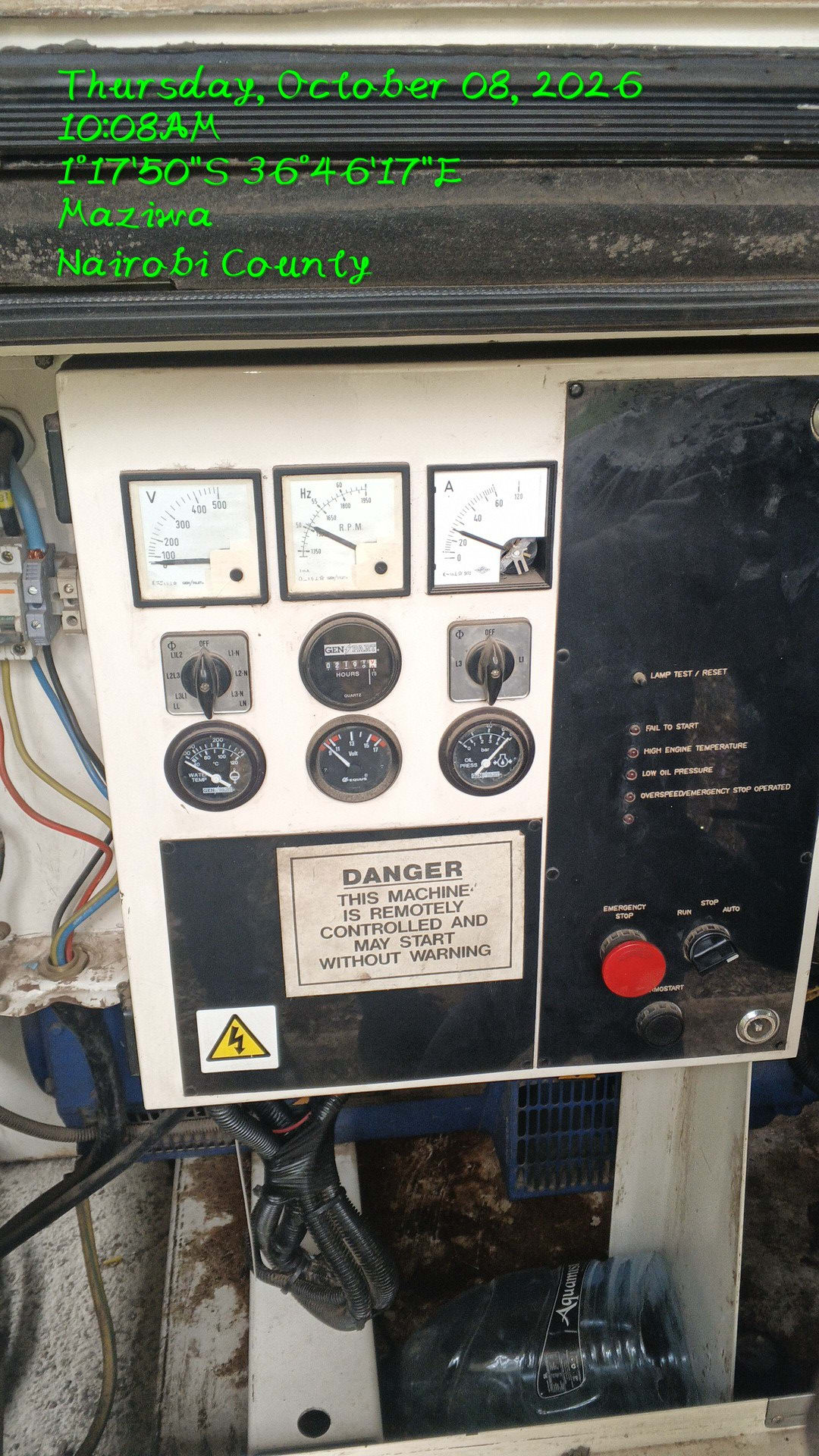
A university on Riara Road relies on a 40 kVA FG Wilson standby generator to maintain power continuity for its operations. During a site assessment, our engineer Daniel identified two critical faults — one in the cooling system and one in the charging system — either of which, left unaddressed, would compromise the generator's ability to start and run reliably when mains power fails. The assessment also noted that the generator was running on manual mode, with automation not yet configured, meaning it would not self-start during a power outage without operator intervention.
Initial Symptoms
- Generator not operating on automatic mode — required manual intervention to start
- No visible or logged overheating events reported prior to assessment, but cooling system found in critical condition on inspection
- Trickle charger found faulty, meaning the starter battery may not have been receiving a maintenance charge between run cycles
What Our Engineer Found
The thermostat was found to be faulty. A failed thermostat prevents the engine from reaching and holding correct operating temperature, which can cause the engine to run too cool (reducing efficiency and increasing wear) or, depending on failure mode, to overheat under load. Replacement was recommended immediately.
The trickle charger was found to be faulty. A trickle charger keeps the starter battery at full charge during standby periods. Without it, the battery voltage gradually depletes and the generator may fail to start when called upon — a serious risk for any facility depending on standby power.
Starting components were found in working order. However, the generator was operating on manual mode only. Automation has not been configured, which means the unit will not self-start on mains failure.
Control panel was functional but not set up for automatic operation. This is consistent with the starting system finding — automation needs to be enabled and tested.
No issues found.
No issues found.
No issues found.
No issues found.
No issues found.
No issues found.
Root Cause
The cooling system fault points to a thermostat that has failed in service — a common wear item on diesel generators that is often overlooked until it causes a visible problem. The trickle charger fault is a separate failure in the battery charging circuit. Both faults likely developed gradually; without a structured maintenance schedule that includes system-level checks, neither would have been caught until the generator failed to perform under a real outage.
What We Did
Daniel conducted a full site assessment across all major generator systems — starting, fuel, cooling, lubrication, electrical, charging, alternator, control, ATS and mechanical. Each system was inspected and rated. The cooling system was identified as critical due to a faulty thermostat, and the charging system was identified as critical due to a faulty trickle charger. Both findings were documented with the specific recommendation that the thermostat and trickle charger be replaced. The manual-only operation of the generator was also flagged, with automation configuration recommended as a follow-up action.
Results
The site assessment provided the university with a clear, system-by-system picture of their generator's condition. Two critical faults were identified before they could cause a breakdown during an actual power outage. With the thermostat and trickle charger replacements carried out, the generator will be in a position to operate within correct thermal parameters and maintain a charged starter battery during standby periods. Enabling automation will further ensure the unit responds to mains failures without requiring manual intervention.
Recommendations
- Replace the faulty thermostat in the cooling system as a priority to restore correct engine temperature regulation
- Replace the faulty trickle charger to ensure the starter battery remains fully charged during standby periods
- Configure the generator and control system for automatic operation so the unit self-starts on mains failure without requiring manual intervention
- Schedule follow-up load testing after the replacements to confirm the cooling system is performing correctly under realistic conditions
- Enrol the generator on a regular preventive maintenance programme to catch component wear before it becomes a critical fault
Lessons for Facility Managers
This assessment is a useful reminder that critical faults can exist on a generator that appears to be running normally. A university's generator may sit in standby for weeks at a time — during which a depleting battery or a failing thermostat will go unnoticed until the unit is called on during a real outage. Two findings stand out here. First, a faulty trickle charger is one of the most common causes of generator no-start failures, and it is also one of the easiest to prevent with routine inspection. Second, a thermostat failure affects engine temperature regulation in ways that may not trigger an alarm until damage has already occurred. The fact that the generator was also running on manual mode only means that even a fully serviceable unit would have failed to respond automatically to a mains outage — a configuration gap that carries the same practical risk as a mechanical fault. Facility managers should not assume a generator is ready just because it starts when tested. A structured site assessment will reveal what a simple start test will not.
Photos from the Site


Case Study FAQ
What does a faulty thermostat do to a diesel generator?
The thermostat regulates coolant flow to keep the engine within its correct operating temperature range. A faulty thermostat can cause the engine to run too cold, which increases fuel consumption and accelerates cylinder wear, or it can cause overheating under load if coolant flow is restricted. Either condition shortens engine life and risks shutdown during an outage.
Why does a standby generator need a trickle charger?
A standby generator's starter battery self-discharges slowly when the unit is not running. A trickle charger keeps the battery at full charge so the generator can start immediately when mains power fails. Without a functioning trickle charger, a battery that has been in standby for several weeks may not have enough charge to crank the engine — causing a no-start at the worst possible moment.
What is the risk of leaving a generator on manual mode only?
A generator set to manual will not respond to a mains power failure on its own. Someone must physically go to the generator, start it, and transfer the load. In a facility where power continuity matters — classrooms, laboratories, server rooms, security systems — the delay or absence of a person to do this means downtime that automatic operation would have prevented entirely.
How often should a standby generator be assessed if it is rarely run?
Generators that sit in standby for long periods are often in worse condition than those that run regularly, because issues like battery discharge, coolant degradation and fuel contamination develop quietly without triggering alarms. A full site assessment at least once a year, combined with short monthly test runs, is the minimum recommended for any facility-critical standby unit.
Can a site assessment find faults that a routine service would miss?
Yes. A routine service focuses on consumables — oil, filters, coolant level. A structured site assessment evaluates every major system against a defined checklist and rates each one. That is how faults like a failing thermostat or a degraded trickle charger get caught before they cause a breakdown. It is a more thorough review of the generator's overall health rather than just its maintenance items.

Eng. Okumu
Lead Technical Reviewer & Auditor
Specialization
Alternator Rewinding & Precision Servicing
Experience
18+ Years Industrial Power Systems
All information in this guide has been field-verified by our engineering team to meet current Kenyan Energy Regulatory Authority (EPRA) standards and manufacturer-specific diagnostic protocols for Perkins, Cummins, and Caterpillar systems.